Is Oberlo A Scam Or Was It Legit? The Full Story

Quick verdict
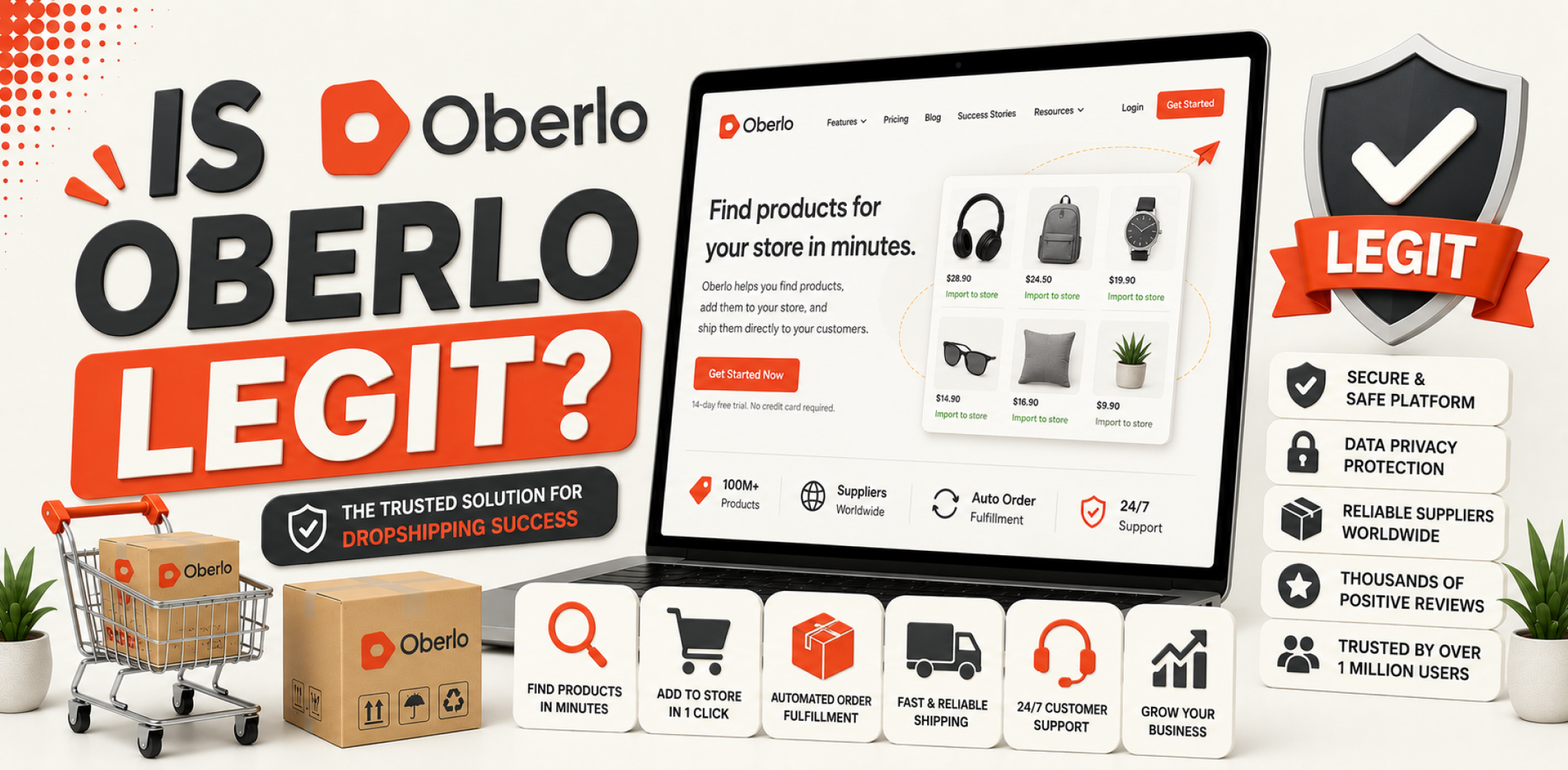
Oberlo was a legitimate Shopify dropshipping app founded in 2015 and acquired by Shopify in 2017. It permanently shut down on June 30, 2022. The platform is no longer available in any form. If you are searching for an Oberlo alternative in 2026, you need a replacement that offers what Oberlo never did: a complete store, built-in ads, and no dependency on a single parent platform.
Key takeaways
- Oberlo was a real, widely used dropshipping app with over 12,600 active stores at the time of its shutdown announcement in May 2022.
- Shopify shut Oberlo down permanently on June 30, 2022, deleting all historical data, products, and supplier connections without a public explanation.
- Oberlo was never a scam, but its biggest structural flaw was total dependency on Shopify, which meant the shutdown was completely outside users’ control.
- As of 2026, Oberlo does not exist as a dropshipping tool; the website now redirects to unrelated content.
- Dropshippers who need a full ecommerce setup today are better served by platforms that combine store, products, and marketing in one place.
What is Oberlo and how did it work?
In 2026, the name Oberlo still draws a lot of searches from people who heard about it through YouTube tutorials, Reddit threads, or old blog posts. So before anything else, here is the short answer: Oberlo no longer exists. It shut down in June 2022. But understanding what it was, how it worked, and why it closed is genuinely useful if you are trying to evaluate your dropshipping options today.
Oberlo was a dropshipping automation app built exclusively for Shopify. It was founded in 2015 by a Lithuanian startup team led by Tomas and Andrius Slimas, based in Vilnius. The core idea was straightforward: merchants could browse products on AliExpress, import them into their Shopify store in a few clicks, and have orders fulfilled automatically when a sale came in. No manual purchasing, no inventory to manage, no warehouse needed.
Shopify acquired Oberlo in April 2017 for a reported $15 million. At its peak, the app processed over $1 billion in gross merchandise volume and was pre-installed for new Shopify merchants, making it one of the most visible entry points into dropshipping for anyone starting out on that platform.
The model worked well for merchants who were comfortable with the limitations: shipping times that were often 2–4 weeks, product quality that varied widely by supplier, and a complete dependency on both Shopify and AliExpress. For people who understood those trade-offs, Oberlo was a fast and relatively cheap way to test products without holding stock.
Was Oberlo legitimate? What the evidence shows
Yes, Oberlo was a legitimate business. It was not a scam, a get-rich-quick scheme, or a platform designed to take money and disappear. It was a real Shopify-owned product used by hundreds of thousands of merchants at its height. But “legitimate” and “reliable” are two different things, and Oberlo’s shutdown in 2022 put that difference in sharp focus.
At its peak, Oberlo’s organic monthly traffic grew from 100,000 visitors to 6.5 million in the four years following the Shopify acquisition. Shopify even pre-installed Oberlo for new merchants, which gave it enormous reach. These are not the metrics of a fraudulent platform.
That said, the 2022 shutdown was handled poorly. Merchants received just 35 days’ notice before all their products, supplier connections, and order history were permanently deleted. There was no detailed public explanation. Shopify’s only official statement described it as a routine product deprecation. For thousands of businesses that had built their entire operation around Oberlo, that was not a reassuring answer.
What complaints did Oberlo users have?
Even before the shutdown, Oberlo had a mixed reputation in the dropshipping community. Reddit threads on r/dropshipping and r/shopify from 2019 to 2022 consistently surfaced the same core frustrations.
Common misconception:
✕ Many new dropshippers assumed Oberlo was a standalone ecommerce platform that would keep running indefinitely as long as they paid their Shopify subscription.
✓ Oberlo was always a third-party app – and once Shopify decided to discontinue it, there was no appeal, no refund, and no data export. Users who had not backed up their product lists lost everything. Dependency on a single app within a single platform is a structural risk, not a minor inconvenience.
The most common complaints from real Oberlo users before the shutdown centered on three areas. First, shipping times: because Oberlo sourced almost exclusively from AliExpress, delivery windows of 3–6 weeks were common for standard ePacket shipping, and customers were not always happy. Second, supplier reliability: AliExpress suppliers varied widely in quality, and Oberlo had limited tools to vet or filter them. Third, customer support: as Oberlo grew, response times slowed and the help documentation was not always kept up to date with platform changes.
Important: Oberlo did not have a Trustpilot profile at the time of its shutdown, so there is no centralized rating to reference. Most user feedback was scattered across Reddit, YouTube comments, and Shopify community forums.
None of these complaints made Oberlo a scam. They made it a product with real trade-offs that worked well for some merchants and poorly for others. The shutdown, however, turned those trade-offs into a business-ending event for stores that had not diversified their toolset.
What do real users say about the Oberlo experience?
How does Oberlo compare to current alternatives?
In 2026, people searching for Oberlo alternatives are typically in one of two situations: they are researching something they heard about years ago, or they are looking for the closest modern replacement. Either way, the competitive landscape has changed significantly since Oberlo’s shutdown. The best comparison is not just feature-by-feature but model-by-model, because the core problem with Oberlo was not just what it did but how it was structured.
The key difference between Oberlo and the strongest modern alternatives is not just features – it is business model independence. Oberlo was entirely hosted inside Shopify, which meant Shopify’s product decisions became your business decisions. Platforms that give you your own store infrastructure do not carry that risk.
Was Oberlo worth it – honest verdict
In its time, Oberlo was a genuinely useful tool for getting a dropshipping store off the ground quickly. It lowered the technical barrier significantly and helped introduce dropshipping as a viable ecommerce model to a broad audience. But the 2022 shutdown exposed the core weakness of the platform: it was not a business, it was a feature inside someone else’s business.
Merchants who built around Oberlo lost data, supplier relationships, and in some cases significant revenue during the forced migration window. The platform was legitimate, but the structural dependency it created was a real risk that not enough people understood before it materialized.
Legitimate platform, but permanently shut down and no longer an option
Oberlo was a real, widely used dropshipping tool, not a scam. It worked for hundreds of thousands of merchants during its operational years. However, it shut down permanently in June 2022 and cannot be installed, accessed, or used in any form. Anyone looking for an Oberlo alternative in 2026 needs a replacement that does not inherit the same structural weakness – complete dependency on a single parent platform over which you have no control.
A free store and an Amazon business – no Shopify dependency
AliDropship gives you a fully built ecommerce store plus a complete Amazon Seller Kit from a single free signup. Two income streams, one platform, and a built-in ad system that can bring in orders from day one. No app-within-an-app fragility.
Looking for an Oberlo alternative that actually works in 2026?
The lesson from Oberlo is not that dropshipping does not work. Dropshipping is a well-established ecommerce model used by millions of sellers worldwide. The lesson is that the infrastructure you build on matters as much as the products you sell. If your entire operation runs inside a single app on a single platform, one corporate decision can end your business with 35 days’ notice.
AliDropship takes a different approach. Founded in 2015 and headquartered in Irvine, California, it has helped launch 1,500,000+ stores across 150+ countries. Store owners have collectively earned $1.5B+ through the platform, which holds a 4.7-star rating on Trustpilot and has been featured in Forbes, Entrepreneur, and Inc. Most importantly, your store is your own – not an app living inside someone else’s ecosystem.
Free turnkey store – built, designed, and filled with products
Your store arrives professionally designed, pre-loaded with 50 bestselling products, and fully optimized to convert. No setup fees, no coding, no design time. You start at the product-testing stage – not the store-building stage. Hosting, SSL, and payment gateway are all included.
Winning products, one-click import
Browse trending and niche items from AliDropship’s catalog – including brand-name and digital products – and import them to your store in one click. The catalog updates regularly so your store always has fresh, competitive inventory without manual research.
Automated fulfillment and real-time tracking
Orders are processed automatically through global supplier connections. Customers receive real-time tracking updates – building trust and reducing support volume. You do not touch the shipping logistics; the platform handles it end-to-end.
Built-in marketing and promotion tools
Email campaigns, discount management, abandoned-cart recovery, live countdown timers, and social media integration are all included or available as add-ons. No prior marketing experience required – the tools guide you through each campaign type.
Beginner-friendly – no coding, no learning curve
An intuitive dashboard walks you through every step. Adding products, running campaigns, and scaling your catalog require no technical knowledge. As your business grows, the platform scales with you – adding features without adding complexity.
AliExpress integration – one-click imports, synced inventory
AliDropship connects directly to AliExpress for one-click product imports, automated order processing, and synced tracking. Inventory stays current with the latest products and prices. Combined with the turnkey store and automated fulfillment, this integration makes the entire operation manageable for one person.
Your own ecommerce store
Fully built, pre-loaded with products, and connected to a built-in ad system. Start selling on day one without building anything from scratch.
Your Amazon seller business
Access a $514B marketplace with 300M active buyers. Your Amazon import file is ready to upload. No inventory. No separate setup required.
Is Oberlo legit?
Is Oberlo still available in 2026?
Why did Oberlo shut down?
What are the risks of using an app-based dropshipping tool like Oberlo?
What is the best Oberlo alternative today?