
Stockkeeping

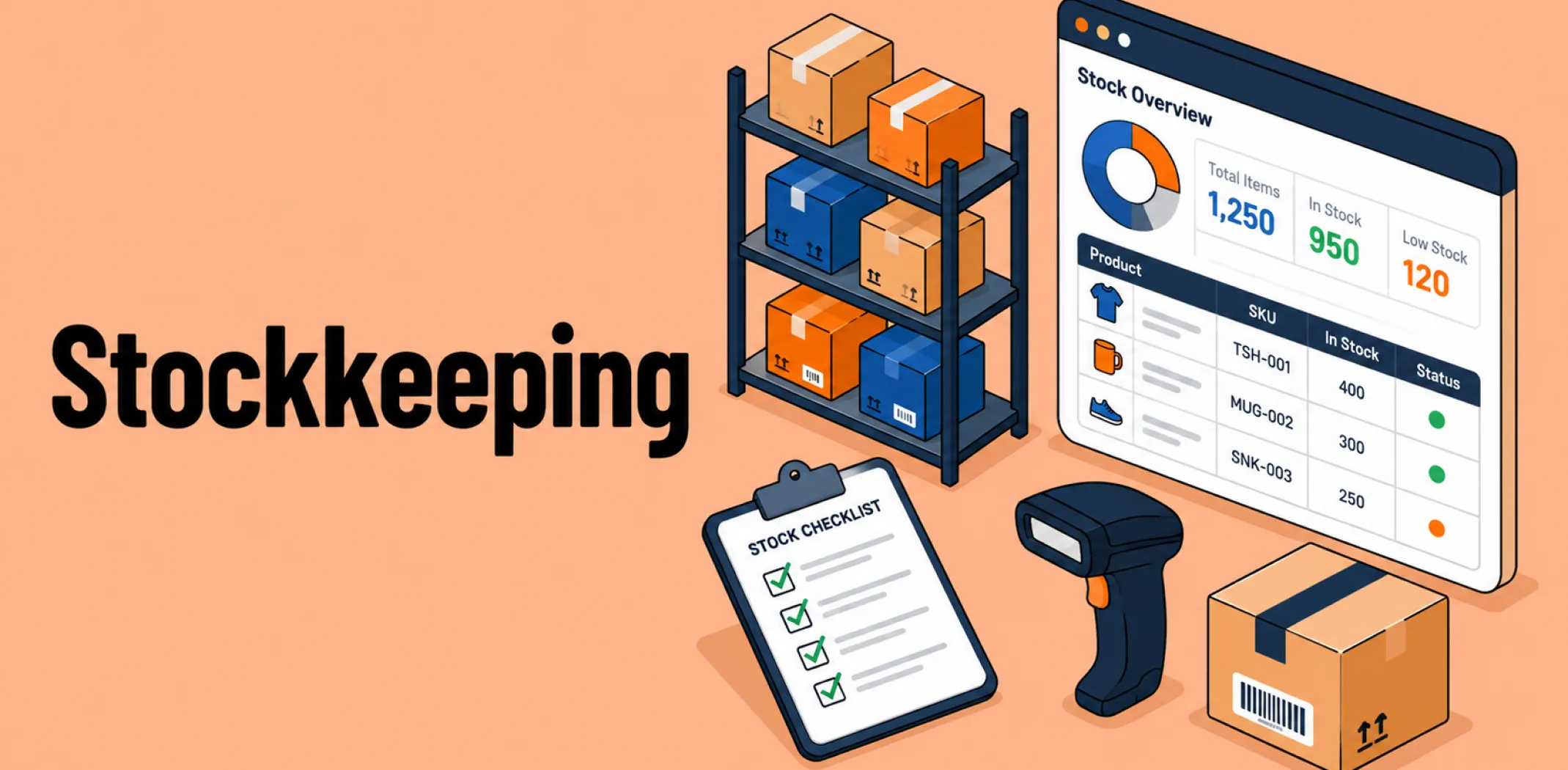
Stockkeeping is the systematic process of recording, monitoring, and maintaining inventory so that a business knows exactly what stock it holds, where it is located, and how much of it is available at any given time.
In practice, stockkeeping covers every activity that keeps inventory data accurate: receiving new stock, assigning identifiers, updating quantities after sales or returns, and flagging items that need reordering.
It is closely associated with the order fulfillment process, since fulfillment depends on knowing which products are on hand. In physical retail and ecommerce alike, poor stockkeeping leads to overselling, stockouts, and inaccurate reporting.
Stockkeeping is distinct from broader inventory management in that it focuses on the operational, day-to-day record-keeping layer rather than the strategic decisions about how much stock to hold or which products to carry. The two functions overlap but are not interchangeable.
How stockkeeping works
- Each product is assigned a unique identifier – typically a SKU (stock keeping unit) – so it can be tracked individually across locations and sales channels.
- When new inventory arrives, the quantities are counted, verified against the purchase order, and recorded in the inventory system.
- Each time a sale is made, the system deducts the sold quantity from the available stock count, keeping the record current.
- Returns are processed and either added back to available stock or flagged as damaged, with the inventory record updated accordingly.
- Stock counts are periodically reconciled through physical checks – known as stock takes or cycle counts – to catch discrepancies between system records and actual quantities on hand.
- When stock falls below a defined threshold, a reorder signal is triggered so replenishment can be arranged before a stockout occurs.
Example
A small ecommerce store sells ceramic mugs through its own website and a third-party marketplace. Each mug variant – by color and size – is assigned a unique SKU. When 30 units of a particular variant arrive from the supplier, the stockkeeper logs the receipt and updates the available count. As orders come in, the system deducts units automatically. At the end of the week, the stockkeeper runs a reconciliation and finds a discrepancy of two units, which are traced to a return processed on the wrong SKU. The correction is made, and the record reflects the accurate count before the next sales period begins.
Key characteristics
- SKU assignment: Every distinct product variant is given a unique identifier that links its physical stock to its record in the inventory system.
- Real-time updating: Stock counts change whenever a sale, return, receipt, or adjustment is logged – accurate records depend on updates being applied promptly.
- Reconciliation: Periodic physical counts are compared against system records to identify shrinkage, damage, or data entry errors.
- Reorder triggers: Minimum stock thresholds are set for each product so that replenishment is initiated before inventory runs out.
- Multi-location tracking: Businesses operating across more than one warehouse or sales channel must track stock separately by location to avoid fulfillment errors.
Related terms
- Warehousing – the physical storage of inventory, within which stockkeeping records are maintained and verified.
- Order fulfillment – the process of picking, packing, and shipping orders, which relies on accurate stock records to execute correctly.
- Supplier – the party that replenishes inventory, whose deliveries are recorded as part of the stockkeeping process.
- Overhead costs – ongoing business expenses that include the systems and labor required to maintain stock records.
- Wholesale – the purchasing model through which inventory is acquired in bulk and then entered into the stockkeeping system upon receipt.
Frequently asked questions
What is the difference between stockkeeping and inventory management?
Stockkeeping refers to the day-to-day operational task of recording and tracking inventory quantities. Inventory management is a broader function that also includes strategic decisions such as how much stock to order, which products to carry, and how to optimize stock levels over time.
Do dropshippers need to perform stockkeeping?
In a standard dropshipping arrangement, the supplier holds and manages the physical stock, so the store owner does not perform traditional stockkeeping. However, monitoring supplier stock availability and syncing product listings to reflect accurate availability is a functional equivalent that serves the same purpose.
What is a stock take?
A stock take – also called a stockcount or physical inventory count – is a manual count of all items on hand, conducted to verify that physical quantities match the figures recorded in the inventory system. Discrepancies found during a stock take are investigated and corrected.
What causes stockkeeping errors?
Common causes include data entry mistakes, unrecorded returns, damaged goods not removed from available counts, and delays between a sale occurring and the system being updated. Regular reconciliation and automated inventory tools reduce the frequency and impact of these errors.
AliDropship: An all-in-one platform for starting dropshipping in 2026
AliDropship is a dropshipping platform that covers store creation, product imports, order automation, and marketing within a single system. It is designed for users with no prior ecommerce experience, though it also supports scaling for more established stores.
🛍️ Free turnkey store
New users receive a free pre-built store – set up, designed, and stocked with products. The store includes a ready-to-use product catalogue and a standard storefront design. It also comes with hosting, a domain, SSL, and payment systems already set up and included.
📦 Products
The platform provides access to a product catalogue covering both trending and niche items, with one-click import to your store. The catalogue is updated regularly to reflect current market availability. Products can be browsed, filtered, and added without leaving the platform.
🚚 Shipping & fulfillment
AliDropship provides access to a vast catalogue of products from global suppliers and handles order fulfillment automatically once a purchase is made. Customers receive tracking information directly, and orders are processed without manual intervention from the store owner.
📣 Marketing & promotion tools
The platform includes built-in marketing tools covering email campaigns, discount management, SEO settings, and social media integration. These are available within the dashboard and do not require third-party subscriptions for basic use.
👌 Ease of use
AliDropship requires no coding knowledge. The dashboard contains all the necessary tools for managing your store, products, and orders in one place. Additional features and products can be added as the store grows without rebuilding the existing setup.
What is the difference between stockkeeping and inventory management?
Do dropshippers need to perform stockkeeping?
What is a stock take?
What causes stockkeeping errors?
Are you ready to become an owner
of a profitable online business?
Free Dropshipping Guide