
Private Label

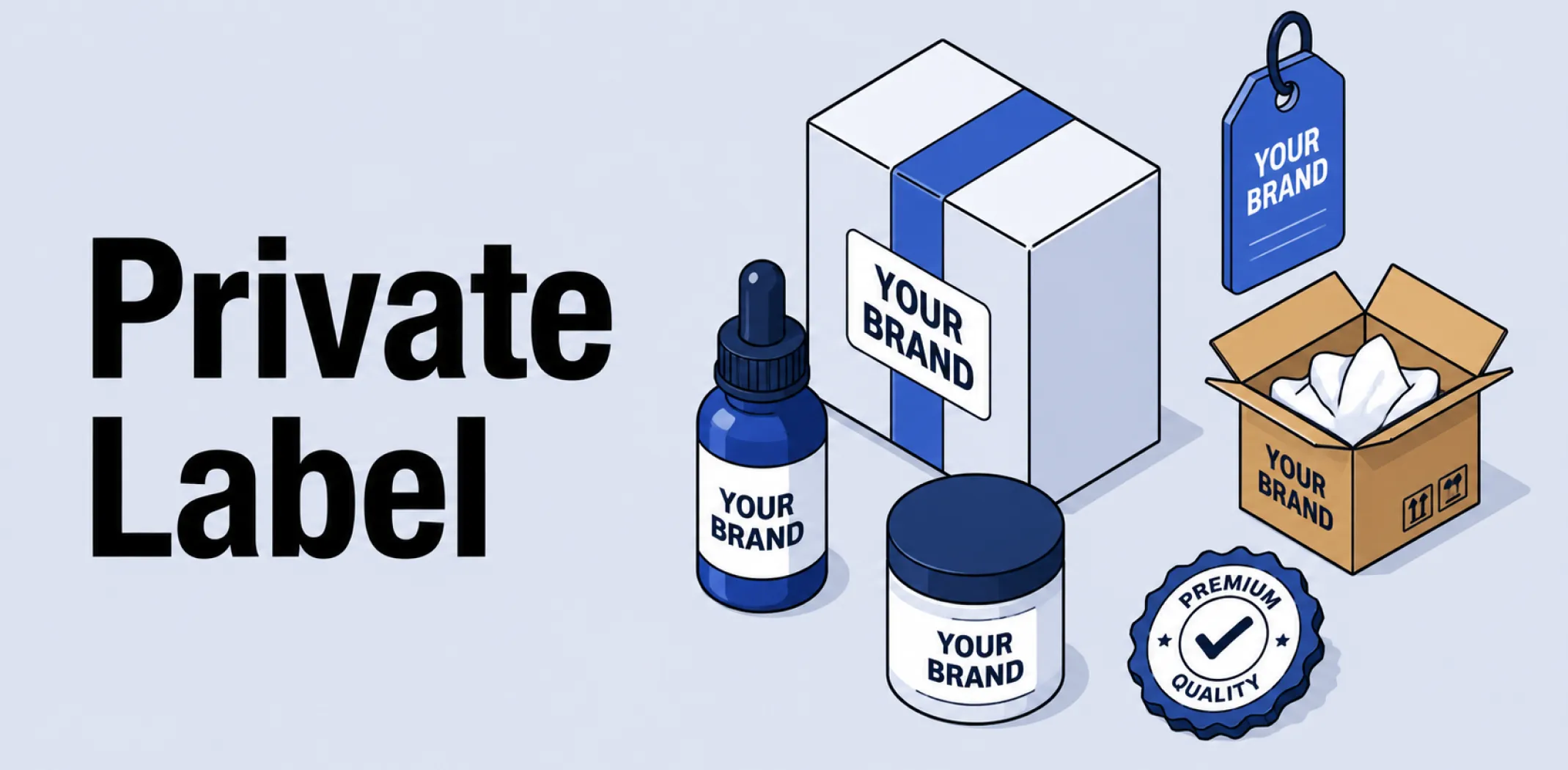
Private label is a retail model in which a seller markets and sells products manufactured by a third party under the seller’s own brand name rather than the manufacturer’s.
In a private label arrangement, the manufacturer produces goods to the seller’s specifications – which may include custom packaging, logo placement, or minor product modifications – while the seller controls the branding, pricing, and customer relationship.
The seller’s name appears on the product; the manufacturer remains invisible to the end consumer. This distinguishes private label from wholesale, where a retailer resells branded goods produced and branded by someone else.
Private label is widely used across physical retail categories including cosmetics, food, apparel, and electronics accessories. In ecommerce, it is often pursued as a progression from standard dropshipping, allowing sellers to move beyond commodity listings toward differentiated, brandable products with higher perceived value.
Example
A seller sources unbranded silicone kitchen utensil sets from a manufacturer through Alibaba. The manufacturer applies the seller’s custom logo to each item and ships them in branded packaging designed by the seller. The finished products are listed on the seller’s store under their own brand name at a price point that reflects the branding rather than the commodity market rate. Customers associate the quality and experience with the seller’s brand, not the factory that produced the goods.
Key characteristics
- Manufacturer invisibility: The producing factory is not identified on the product or packaging; all branding belongs to the seller.
- Seller-controlled branding: The seller determines the product name, visual identity, packaging design, and positioning in the market.
- Specification flexibility: Sellers can request adjustments to formulation, materials, dimensions, or packaging within the manufacturer’s production capabilities.
- Minimum order requirements: Most manufacturers require a minimum order quantity before producing private label goods, creating an upfront inventory commitment.
- Higher margin potential: Because the product is not available under the same branding elsewhere, sellers face less direct price competition than with generic or wholesale goods.
Related terms
- Wholesale – a purchasing model in which a retailer buys pre-branded goods in bulk from a supplier and resells them under the original brand.
- Supplier – the manufacturer or distributor that produces or stocks the goods a seller sources for private label or standard dropshipping.
- Niche market – a defined segment of buyers with specific needs, often the target audience for private label products built around a focused category.
- Product positioning – the strategy used to define how a product is perceived relative to competitors, a central activity in building a private label brand.
- Ecommerce – the broader category of online retail within which private label selling operates.
Frequently asked questions
What is the difference between private label and white label?
White label refers to a generic product sold to multiple retailers, each of whom applies their own branding. Private label typically implies a more exclusive arrangement – the product is produced to a specific seller’s specifications and is not sold to other retailers under a different name. In practice, the terms are often used interchangeably, though private label carries a stronger implication of product customization.
Is private label the same as dropshipping?
No. Standard dropshipping involves reselling existing supplier products without modification or custom branding. Private label requires the seller to brand the product and typically involves holding or pre-ordering inventory. Some sellers combine elements of both by sourcing private label goods through suppliers who handle fulfillment, a model sometimes called private label dropshipping.
What are the main risks of private label selling?
The primary risks include minimum order quantities that require upfront capital, the possibility of unsold inventory if demand is misjudged, and quality control challenges when working with overseas manufacturers. Brand building also takes time and marketing investment before a private label product gains consumer recognition.
Can private label products be sold through dropshipping?
In some cases, yes. Certain suppliers offer branded fulfillment services in which they store the seller’s private label inventory and ship orders directly to customers on the seller’s behalf. This arrangement combines private label branding with a dropshipping-style order fulfillment model, though it is less common than standard dropshipping and typically requires a prior inventory commitment.
AliDropship: An all-in-one platform for starting dropshipping in 2026
AliDropship is a dropshipping platform that covers store creation, product imports, order automation, and marketing within a single system. It is designed for users with no prior ecommerce experience, though it also supports scaling for more established stores.
🛍️ Free turnkey store
New users receive a free pre-built store – set up, designed, and stocked with products. The store includes a ready-to-use product catalogue and a standard storefront design. It also comes with hosting, a domain, SSL, and payment systems already set up and included.
📦 Products
The platform provides access to a product catalogue covering both trending and niche items, with one-click import to your store. The catalogue is updated regularly to reflect current market availability. Products can be browsed, filtered, and added without leaving the platform.
🚚 Shipping & fulfillment
AliDropship provides access to a vast catalogue of products from global suppliers and handles order fulfillment automatically once a purchase is made. Customers receive tracking information directly, and orders are processed without manual intervention from the store owner.
📣 Marketing & promotion tools
The platform includes built-in marketing tools covering email campaigns, discount management, SEO settings, and social media integration. These are available within the dashboard and do not require third-party subscriptions for basic use.
👌 Ease of use
AliDropship requires no coding knowledge. The dashboard contains all the necessary tools for managing your store, products, and orders in one place. Additional features and products can be added as the store grows without rebuilding the existing setup.
What is the difference between private label and white label?
Is private label the same as dropshipping?
What are the main risks of private label selling?
Can private label products be sold through dropshipping?
Are you ready to become an owner
of a profitable online business?
Free Dropshipping Guide